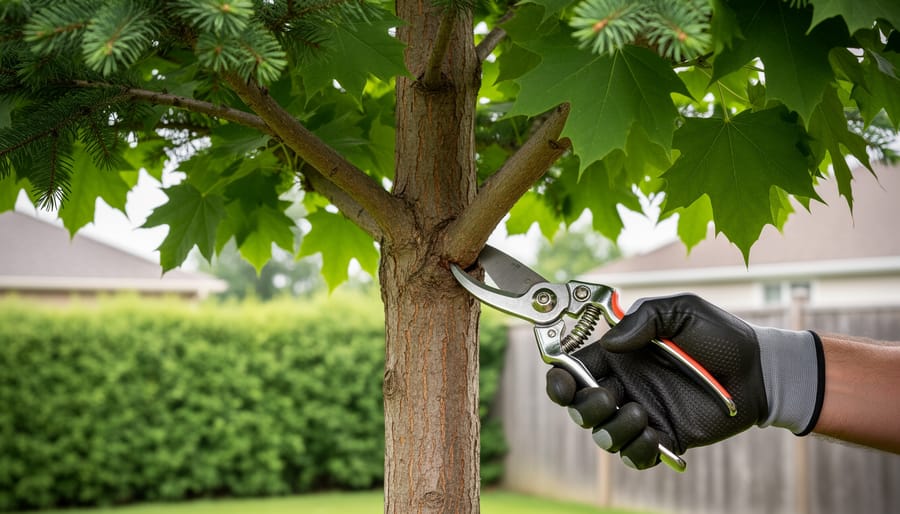
Proper tree pruning follows three core guidelines: cut at the right time of year, remove no more than 25% of the canopy in a single season, and always make cuts just beyond the branch collar to promote healthy healing. These rules protect trees from disease, structural failure, and long-term decline. Most pruning mistakes happen because homeowners don’t understand that plants as living systems respond to cuts as wounds that require energy and time to seal.
Here in Edmonton, we’ve worked with families across the region for years, and we see the same pattern: well-intentioned pruning done at the wrong time or with dull tools creates entry points for disease and weakens the tree’s defenses. Winter pruning works best for most species because trees are dormant and pathogens are inactive. Spring bloomers like lilacs need pruning right after flowering, while oak and elm require special timing to avoid attracting beetles that spread deadly diseases.
The branch collar, that slight swelling where a branch meets the trunk, is your visual guide for every cut. Sever too close and you damage the tree’s natural barrier zone. Cut too far away and you leave a stub that invites rot. This single detail separates pruning that strengthens trees from pruning that slowly kills them.
Whether you’re shaping a young maple or removing storm damage from a mature spruce, following these guidelines means your trees will close wounds faster, maintain their structure, and thrive for decades. The techniques are straightforward once you understand why each rule exists.
Why Tree Pruning Guidelines Matter for Edmonton Homeowners
Following proper tree pruning guidelines isn’t just about making your trees look tidy. It’s about protecting your investment, keeping your family safe, and preserving the green canopy that makes Edmonton neighborhoods like Beaumont and Saint Albert beautiful places to live.
When you follow established pruning guidelines, you actively prevent disease from spreading through your tree and to neighboring plants. Correct cuts heal cleanly, sealing out fungi and bacteria that attack wounded tissue. Poor pruning tears bark, leaves jagged wounds, and creates entry points for Dutch elm disease, fire blight, and other pathogens that thrive in Alberta’s climate.
Proper pruning also guides your trees toward strong, balanced growth patterns. Removing competing leaders, crossing branches, and weak angles now prevents structural failures years down the road. Trees develop sturdy branch architecture that withstands heavy snow loads and summer windstorms, common hazards in Edmonton winters and unpredictable prairie weather.
The safety benefits matter just as much. Dead or damaged branches become missiles during storms, threatening roofs, cars, power lines, and people below. Following pruning guidelines means you identify and remove these hazards before they cause injury or costly property damage. For families with children playing in the yard or neighbors nearby, this isn’t optional maintenance, it’s essential risk management.
Finally, your careful pruning contributes to the urban forest canopy that filters air, cools streets, and defines the character of local communities. Healthy, well-maintained trees increase property values, reduce energy costs through shade, and create the green infrastructure that makes Edmonton-area neighborhoods thrive. When homeowners prune responsibly, everyone benefits from cleaner air, cooler summers, and more vibrant public spaces.
Essential Tools and Materials for Safe Tree Pruning
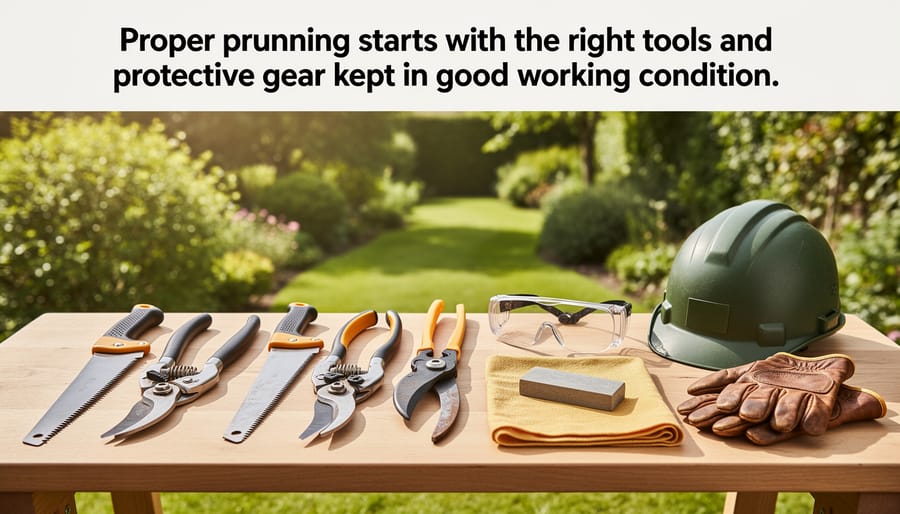
Before you start cutting branches, you need the right equipment. Using proper tools protects both you and your trees, dull or inappropriate tools tear bark instead of making clean cuts, leaving your trees vulnerable to disease and pest invasion. Here’s what every Edmonton homeowner should have in their pruning toolkit.
Hand Pruners (Secateurs)
These are your go-to tool for branches up to 2cm in diameter. Bypass pruners, which work like scissors with two sharp blades crossing, make the cleanest cuts on live wood. They’re perfect for shaping shrubs, removing small dead twigs, and precision work where you need control. Keep them sharp and clean between uses to prevent spreading disease from tree to tree.
Loppers
When branches grow too thick for hand pruners, roughly 2cm to 5cm in diameter, reach for loppers. Their long handles give you leverage and reach without a ladder for many cuts. Bypass loppers work best for living branches, while anvil-style loppers can handle dead wood. Quality loppers save your arms from fatigue during longer pruning sessions.
Pruning Saws
For branches between 5cm and 10cm thick, you need a pruning saw. Curved blades cut on the pull stroke, which gives you better control and requires less effort than push-cutting. A folding pruning saw is safer to carry and store. This is the tool you’ll use for the three-cut method on larger limbs.
Essential Pruning Tools by Branch Size:
– Hand pruners: branches up to 2cm diameter (pencil-thick)
– Loppers: 2cm to 5cm diameter (thumb to two-finger width)
– Pruning saw: 5cm to 10cm diameter (small wrist-size)
– Pole pruner: overhead branches within 4 meters, up to 4cm diameter
– Professional equipment needed: branches over 10cm, heights above 4 meters, or work near power lines
Pole Pruners
These extend your reach for overhead branches you can’t access safely from the ground. Manual pole pruners combine a bypass pruner head with a long pole (some extend to 4 meters or more) and a rope-pull mechanism. They work well for branches up to about 4cm diameter. Recognize their limits, if you’re stretching awkwardly or the branch feels too thick, it’s time for professional help.
Safety Gear
Don’t skip protection. Safety glasses or a face shield guard against sawdust and falling debris, Edmonton’s dry summers make bark fragments especially irritating. Heavy-duty gloves protect your hands from cuts, splinters, and blisters. If you’re using a ladder, ensure it’s rated for your weight plus tools, place it on level ground, and have someone spot you. Steel-toed boots add protection if larger branches drop.
When to Call Professionals
Some projects exceed homeowner equipment and safety limits. If branches are thicker than 10cm, if the tree is near power lines, if you need to climb more than one ladder height, or if large limbs overhang your roof or neighbor’s property, professional arborists have the specialized gear and training to work safely. At Mosai, we use bucket trucks, rigging systems, and commercial-grade saws that homeowners shouldn’t attempt to operate, and our two decades serving Edmonton communities mean we know exactly how to handle challenging situations.
Starting with the right tools sets you up for pruning success, but having them isn’t enough. You need to know how to use them safely, which we’ll cover next.
Safety First: Critical Warnings Before You Start Pruning
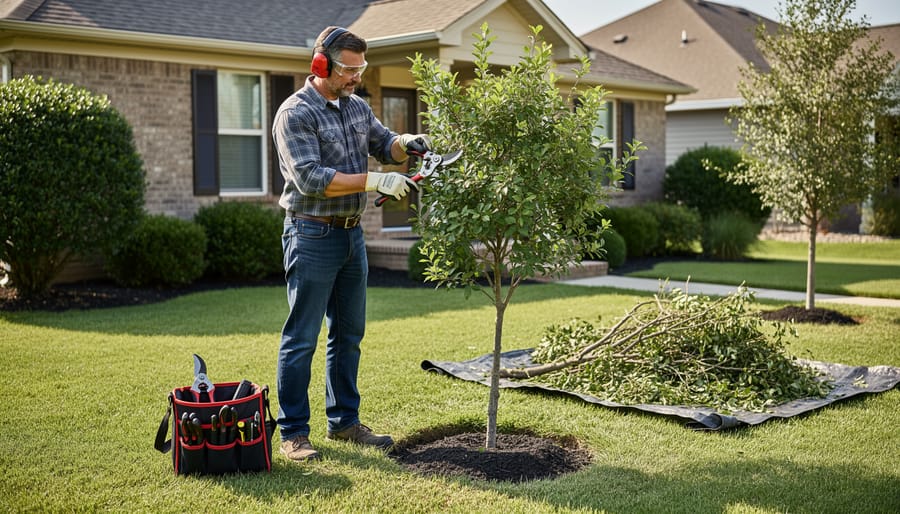
Before you make a single cut, take the time to assess hazards and prepare properly. Many tree pruning injuries happen because homeowners underestimate risks or rush into the work without proper precautions.
Electrical lines pose the single greatest danger during pruning work. Even branches that aren’t touching wires can conduct electricity if they fall the wrong way or if you misjudge distance. When in doubt, stay clear and call in professionals who have the training and equipment to work safely near power.
Ladder safety deserves serious attention, especially on Edmonton’s uneven terrain and sloped yards. Always place your ladder on stable, level ground and have someone hold it steady while you work. Never overreach to one side, move the ladder instead. If the branch you’re cutting is above your shoulders or requires you to lean out from the ladder, stop. That’s when accidents happen.
Recognize your limits honestly. Trees taller than six meters, branches thicker than your forearm, or work that requires climbing into the canopy all call for professional equipment and expertise. At Mosai, we’ve seen too many close calls from homeowners who thought they could handle just one more cut. There’s no shame in knowing when a job exceeds your skill level or comfort zone.
Weather matters more than you might think. Wet bark is slippery, wind can shift branches unpredictably, and cold temperatures make both you and your tools less reliable. Save pruning work for calm, dry days when you can concentrate fully.
Always wear safety glasses to protect against sawdust and flying debris, heavy-duty gloves to maintain grip and prevent cuts, and long sleeves to shield your arms from scrapes. If you’re using a chainsaw, add hearing protection, steel-toed boots, and chainsaw chaps to your gear list. Mosai prioritizes safety in every project we undertake, and we encourage every homeowner to do the same, your wellbeing is worth the extra preparation time.
The Golden Rules: Core Tree Pruning Guidelines
Understanding Proper Cut Placement
Proper cut placement is the single most important factor in helping your tree heal quickly and resist disease. Every pruning cut creates a wound, and where you make that cut determines whether the tree can seal it efficiently or struggles with decay for years.
Start by locating the branch collar, the slight swelling where the branch meets the trunk or parent limb. This collar contains specialized cells that form a protective barrier over wounds. Your cut should preserve this collar entirely, angling just outside its edge. Never cut flush against the trunk, as this removes the tree’s natural defense system and exposes interior wood to rot.
Look for the branch bark ridge, a raised line of bark in the crotch between branch and trunk. Position your cut so it angles away from the trunk at roughly the same angle as this ridge. For branches growing at narrow angles, you’ll cut more steeply; wider-angle branches need a shallower cut.
Avoid leaving stubs, branch remnants beyond the collar that can’t heal and become entry points for insects and fungi. Equally, resist the urge to cut too close. That “clean” flush cut actually damages the trunk and invites the very problems proper pruning prevents. The collar should remain visible as a small ring after you finish.
Timing Your Pruning by Season and Species
Timing matters as much as technique when following tree pruning guidelines. Prune at the wrong time, and you risk weakening the tree or inviting disease, even if your cuts are perfect.
In Edmonton’s climate, most deciduous trees, maples, elms, ash, should be pruned during late winter dormancy, typically February through early March, before buds break. The tree’s energy is stored in the roots, wounds seal quickly once growth resumes, and insects that spread disease remain inactive. Avoid pruning birch and maple in early spring when sap flows heavily; wait until summer or prune in deep winter.
Spring-flowering species like crabapple and cherry bloom on last year’s growth, so prune them immediately after flowers fade, usually late May or June in Alberta. Pruning earlier removes this season’s blooms; pruning later cuts next year’s flower buds.
For disease-prone trees such as oak and elm, follow municipal fire blight and Dutch elm disease guidelines. In Edmonton, elm pruning is banned from April 1 to September 30 to prevent beetle transmission. Choose dry weather for all pruning to limit fungal spread.
Emergency situations, broken branches threatening property or hanging hazards, override seasonal guidelines. Remove dangerous wood immediately, then schedule proper corrective pruning during the ideal window for that species.
Step-by-Step: How to Prune Your Tree Properly
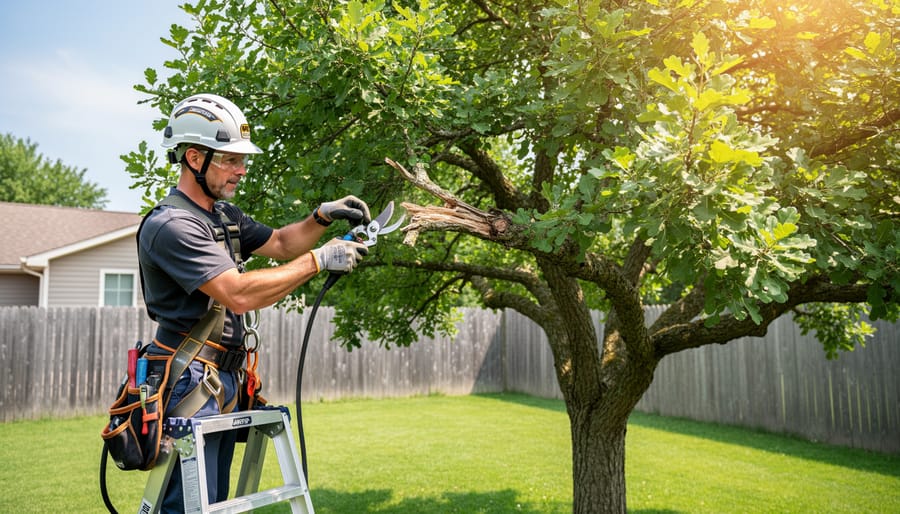
Start your pruning project on a calm, dry day when you can see clearly and work safely. Grab a notebook or your phone, you’ll want to document problem areas before you begin cutting.
Walk slowly around the entire tree, looking up into the canopy from multiple angles. Circle any branches that are dead (no buds, brittle, discolored bark), diseased (cankers, fungal growth, oozing sap), damaged (cracked, split, hanging), or dangerous (rubbing against others, growing toward structures or power lines). These are your 4 D’s, and they’re your priority targets.
Step back and visualize the tree’s natural form. Most species have a recognizable shape, maples tend toward rounded crowns, spruce are conical, oak branches spread wide. Your goal is to enhance that natural architecture, not fight it. Imagine removing each problem branch and picture what the tree will look like afterward. If a cut would leave a large gap or create an unbalanced appearance, reconsider your approach.
Now you’re ready to prune systematically:
- Remove all dead branches first, working from smaller to larger. These pose immediate hazards and harbor pests that can spread to healthy wood.
- Address diseased branches next, cutting back to healthy tissue where the wood shows no discoloration. Disinfect your tools with rubbing alcohol between cuts to prevent spreading pathogens.
- Tackle damaged branches, removing the injured portion back to a strong lateral branch or the trunk using proper cut placement you learned earlier.
- Eliminate dangerous branches, those crossing and rubbing, growing inward toward the center, or threatening structures. Choose which branch to keep based on stronger attachment angle and better position.
- For any branch thicker than your thumb (roughly 3cm), use the three-cut method: first undercut 30cm from the trunk, then top-cut slightly farther out to remove the weight, finally remove the stub just outside the branch collar.
- After each few cuts, walk back 3-5 meters and assess your progress. Does the tree still look balanced? Have you maintained its natural shape? Are you approaching the 25% removal limit?
- Stop when you’ve addressed all priority issues or reached your removal limit, whichever comes first. Resist the urge to keep cutting just because you have momentum.
- Gather all cut branches and debris. Chip smaller material for mulch or bag it for yard waste collection. Inspect larger pieces for firewood potential if the wood is healthy.
Throughout the process, keep your tools sharp and your cuts clean. Ragged tears invite decay and slow healing. If a branch feels too heavy or awkward to control safely, that’s your signal to call in professional help.
Take photos when you finish. Comparing before-and-after images helps you learn what works and builds your confidence for next season’s pruning tasks.
After the Cut: Verifying Your Work and Next Steps
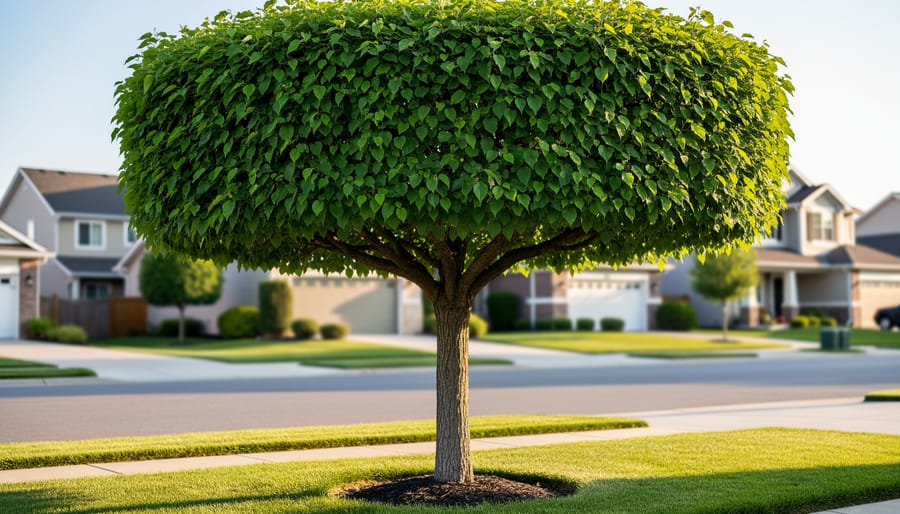
Once you’ve completed your pruning cuts, stepping back to verify your work protects the tree’s health and your investment of time. Start by walking around the tree from several angles to confirm it maintains its natural form, pruning should enhance, not reshape the tree’s inherent structure. If one side looks sparse or the canopy appears lopsided, you may have removed too much material from certain areas.
Inspect each cut site closely. Clean cuts positioned just beyond the branch collar should appear smooth without torn bark or ragged edges. Stubs longer than a few millimeters invite decay, while flush cuts that remove the collar compromise the tree’s natural defense system. Run through a quick mental tally: did you stay within the one-third guideline for total canopy removal? Count the major branches you removed and estimate their volume compared to what remains. If you’re uncertain, you probably went too far.
Over the following two to four weeks, monitor your tree for signs of stress. Check for wilting leaves, premature leaf drop, or excessive sap flow from cut sites. Healthy healing shows slight swelling around the wound as callus tissue forms, sealing the cut naturally within the first growing season.
Don’t seal cuts with wound dressing or paint, research shows these products trap moisture and encourage rot rather than preventing it. The tree’s own compartmentalization process works better when left exposed to air.
Document your work with dated photos showing which branches you removed and the tree’s overall shape. These records help you plan future pruning sessions and avoid over-pruning in subsequent years. Most trees benefit from annual inspections, but you’ll only need to prune every two to three years unless storm damage or disease appears. Mark your calendar for a follow-up check next spring to catch any deadwood that emerges or structural issues requiring attention before they worsen.
Common Pruning Mistakes to Avoid
Even experienced homeowners fall into common pruning traps that can permanently damage trees or create dangerous situations. Recognizing these mistakes helps you avoid costly problems down the road.
Topping, cutting main branches back to stubs or making severe heading cuts, ranks as the most damaging error. This practice removes the tree’s food-producing crown, triggers weak sprouts that break easily, and creates large wounds that invite decay. Topped trees never regain their natural form and often become hazards within a few years.
Removing too much canopy at once stresses trees severely. Taking more than 25-30% of live growth in a single season forces the tree to exhaust energy reserves trying to recover, leaving it vulnerable to pests, disease, and winter damage. Spread major pruning work across multiple seasons instead.
Flush cuts that remove the branch collar prevent proper wound closure, while leaving long stubs creates entry points for decay organisms. Both mistakes compromise the tree’s natural defense systems. Always cut just outside the visible branch collar.
Pruning at the wrong time, say, cutting oaks during spring when disease spreads rapidly, exposes trees to infections they could otherwise avoid. Late-season pruning in Edmonton stimulates new growth that won’t harden off before frost.
Dull tools crush living tissue rather than cutting cleanly, and dirty blades transfer pathogens between cuts. Clean and sharpen your equipment before every session, and sanitize between trees.
Ignoring safety protocols leads to injuries every season. Overreaching from ladders, cutting near power lines, and working alone on large branches all put you at serious risk.
After two decades serving Edmonton neighborhoods, Mosai has seen these mistakes repeatedly. Our team helps local families maintain healthy trees by applying proper pruning guidelines from the start, saving you from problems that take years to manifest.
Frequently Asked Questions About Tree Pruning Guidelines
Can I prune my trees in summer?
Yes, you can prune in summer for light corrective work or to remove dead and damaged branches. However, avoid heavy pruning during active growth periods, as trees lose more sap and energy reserves when cuts are made in summer heat.
How much of my tree can I safely remove at once?
Never remove more than 25-30% of a tree’s canopy in a single season. Removing too much foliage stresses the tree, depletes its energy reserves, and leaves it vulnerable to disease and pests.
Do I need to seal pruning cuts with wound dressing?
No, research shows that wound dressings don’t prevent decay and can actually trap moisture against the cut. Trees heal best when cuts are made properly and left exposed to air, the tree’s natural compartmentalization process does the rest.
What should I do if a branch is near power lines?
Never attempt to prune branches near power lines yourself. Contact your utility company or a certified arborist with line-clearance training, working near electrical lines is extremely dangerous and requires specialized equipment and certification.
Beyond these common questions, homeowners often wonder when it makes sense to call in professional help. If you’re facing large branches over 10cm in diameter, trees taller than you can safely reach from the ground, complex structural issues, or work near buildings and utilities, professional expertise protects both you and your tree. For newly planted trees, resist the urge to prune heavily in the first year. Young trees need their foliage to establish strong root systems. Limit yourself to removing broken branches and correcting major structural problems, save shaping work for year two or three when the tree has settled into its new home.
Edmonton’s unique climate raises additional questions. Many homeowners ask whether our cold winters change standard pruning guidelines. The fundamentals remain the same, but timing matters more here. Late fall pruning can leave cuts vulnerable through our harsh winters, so aim to finish major work by early fall or wait until late winter dormancy. Spring thaw brings its own considerations, avoid pruning birch, maple, and walnut species as sap begins flowing, since they’ll bleed excessively from fresh cuts during this period.
Following proper tree pruning guidelines protects your investment in your property’s landscape while safeguarding the health of the trees that provide shade, beauty, and ecological benefits to our Edmonton neighborhoods. You’ve now learned the core principles: respect the one-third rule, make clean cuts at the branch collar, time your work to your tree’s dormancy, and always prioritize safety over speed.
Start small if you’re new to pruning. Tackle a few lower branches on a young tree, practice the three-cut method, and build your confidence with each project. There’s real satisfaction in shaping a healthier tree with your own hands. But recognize your limits. Large trees, branches near power lines, diseased wood, and complex structural problems demand professional expertise and equipment. Knowing when to call for help is as important as knowing how to prune.
At Mosai, we’ve spent more than two decades helping families across Edmonton, Beaumont, Saint Albert, and surrounding communities care for their trees. We’re not just a service provider. We’re your neighbors, and we build lasting relationships rooted in trust, knowledge, and genuine care for the urban forest we all share. Whether you need guidance on a DIY project or full-service pruning that follows every guideline to the letter, we’re here to support you.
Reach out whenever you’re ready. Let’s keep your trees healthy, your property safe, and our community green for generations to come.